opus they
Rationale and objectives
All humanity is facing a series of interconnected global crises: ecological problems, geopolitical instability and technological challenges. Human beings have tended to define the natural world as something outside themselves, something that can be dominated by human technologies for the benefit of humanity. The situation is unsustainable, and finding ways of collectively challenging anthropocentric perspectives has become more crucial than ever. 'opus they' is intended as a research platform where artists, architects, designers and others can contribute to an integrative approach to addressing global crises, through processes that promote cooperation and ethical action. It is inspired by the need to think beyond human-centred issues and the need to reconfigure traditional understandings of matter and agency. What is required is a more relational form of creative practice that decentres the subjectivity of human inhabitants and draws attention to communal processes of becoming and the fluid nature of subjectivity. The self is reconceptualised in relation to the broader ecological and technological contexts, promoting ethical responsibility and creative potential in a world in flux. The arts can play a crucial role in dissolving the artificial boundaries that people often construct between themselves and the nonhuman world. Art can reveal an uncanny sense of reality that helps people seek new modes of thinking and feeling that address their relationship with the world and with others.
'opus they' looks into ways of using art and design to address anthropocentric perspectives and improving collective creative platforms, encouraging interdisciplinary collaborations. It seeks to foster awareness about interconnected global challenges and decentralised, flexible and participatory forms of labour that promote democratic dialogue and decision-making strategies.
Research methodology
Apart from engaging with arts-based research and a review of relevant literature, 'opus they' seeks to engage other stakeholders to access personal experiences and observations related to different fields of expertise, theoretical perspectives and critical evaluations. The research makes use of Grounded Theory, an effective framework for accessing data that can inform post-anthropocentric art and design. It facilitates data-driven insights by collecting and analysing data to reveal patterns, relationships and emergent themes. The research integrates diverse data sources and disciplines, addressing dimensions in various aspects of social, political and ecological fields. Collaborative creative processes that integrate data gathered during interviews can develop prototypes based on emergent themes and generate innovative and nuanced perspectives.
Opus They’s practice is grounded in a dialogue between artistic research and methods drawn from the social sciences. The collected material is analysed thematically to identify recurring ideas that are organised into a series of codes.
Research carried out by Opus They in Malta resulted in a series of codes that were understood as points of departure for creative works.
Codes
Social dimension (community) and individuality: Several interviewees referred to a sense of individualism that often overshadows shared needs and perspectives.
General abstractions and specific realities: The research brought to the fore the need to avoid generalisations about the ‘non-anthropocentric’. It is crucial to locate critical analyses in concrete and lived contexts that can actually be quite diverse.
The role of the arts: While the arts cannot be expected to ‘save the world’, several interviewees spoke about the value of addressing current challenges through the more ambiguous, participatory and interdisciplinary spaces associated with artistic forms of expression.
Extractivism: The extraction of material resources for financial gain creates power imbalances, causes environmental damage and is historically linked to colonialism and the subjugation of groups of people.
Avoiding binary thinking: Binary thinking oversimplifies complex realities, pushing people into polarizing viewpoints about ‘nature’ and ‘humanity’ that make it difficult to envision inter-relationships.
Defining the human: The importance of keeping the definition of the ‘human’ perennially ‘open’ was referenced several times by different interviewees.
Destabilisation / unknown future: We are living in destabilising times that feel unrecognisable or almost alien. Finding ways of living together by pooling different forms of knowledge has become more crucial than ever.
Choose + Format + Respond
One of the central tasks in Opus They was the development of a model for collective labour that would blur disciplinary boundaries and encourage hybrid propositions. The development of such a model would need to be based on the research codes that had emerged from interviews and focus groups previously conducted by the team.
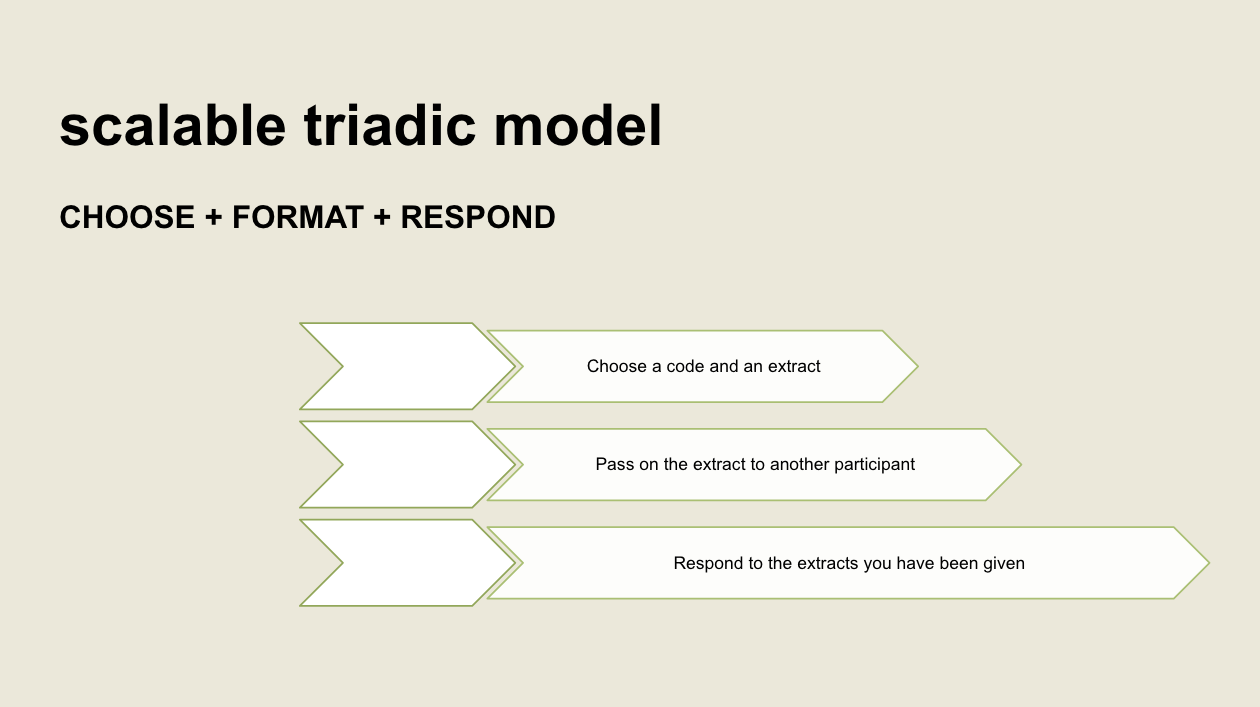
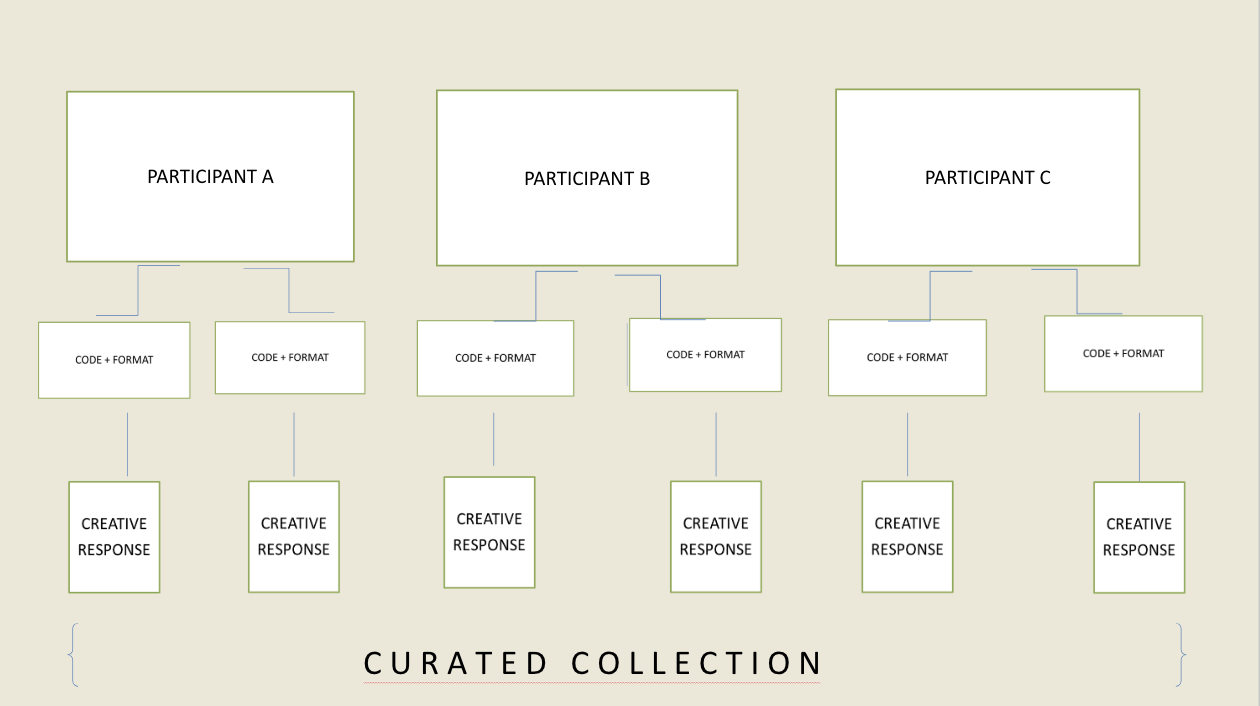
For this purpose, we developed the scalable triadic model CHOOSE + FORMAT + RESPOND, which functions like a creative game. In this model, each person chooses a research code and an extract related to that code for each other participant in the ‘game’. After receiving the code and extract, each participant would be tasked with developing a creative response to the verbal prompt.
The model allows for creative changes or minor additions.
CHOOSE: Choose any extract from interviews, focus groups, etc.
FORMAT: The interview extracts can be changed into a question or an instruction.
RESPOND: Participants respond freely and speculatively to the extracts they have received.
This model can be integrated into creative workshops, fostering further reflections on disciplinary translation (for example, from philosophy to architecture). This staged methodology is simultaneously a form of research and a generative output, i.e. arts-based research.